
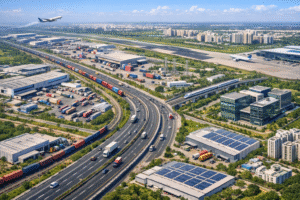
Industrial corridors are regions created from a government plan and organized in a way for industries, manufacturing units, logistics hubs, and modern infrastructure. They may serve as the bridge between major cities, ports, highways, railways, and airports to provide the fastest, cheapest options for moving goods. Industrial Corridors exist as a mechanism for creating strong foundations to support the productive growth of industries, thereby helping the overall economy of a country grow.
The role of industrial corridors is significant in developing countries, particularly India. They relieve pressure on congested urban areas and create urban areas outside the city (namely, industrial towns) because industrial corridors are planned with necessary infrastructure (such as transportation, energy supply, water supply, housing, and digital connectivity) to accommodate the establishment of factories and offices. Such planned development results in the facilitator of companies establishing operations with fewer concerns (e.g. traffic congestion, loss of power, and availability of land).
In addition, industrial corridors will encourage the investment of both domestic and foreign Investors. The existence of well-developed infrastructure and government incentives will provide investors with the confidence that will motivate them to invest capital into existing or new industries, such as the manufacturing, logistics, IT, automotive, electronics, and textile industries. As industries increase, the creation of jobs, production capacity, and export levels will increase.
Infrastructure Growth Through Corridors
One of the most important ways that industrial corridors support an economy’s overall growth is through the improvement of infrastructure. Infrastructure is the foundation of any economy, and industrial corridors primarily focus on constructing world-class facilities.
The following are areas in which industrial corridors assist in improving infrastructure:
**Transport Infrastructure:** New highways, expressways, rail freight corridors (to connect ports and airports), and other forms of land transport infrastructure are created. This is done to aid manufacturing and reduce the cost and time associated with supplying goods to market, thereby providing increased competitiveness to manufacturing companies.
**Power and Energy Supply:** Uninterrupted power supply is critical to most of the manufacturing industry. Industrial corridors create and provide uninterrupted power generation and transmission through power plants, renewable energy sources, and modern grid systems.
**Water and Waste Management:** Planned water supply systems and waste treatment facilities are constructed to support industries while protecting the environment.
**Digital Infrastructure:** High-speed internet access, data centers, and smart technologies are being developed in all industrial corridors in order to support the current industrial and digital economy.
**Urban Infrastructure:** All industrial corridors develop residential housing, hospitals, schools, and commercial spaces for workers and their families.
By providing a unified set of infrastructure to support industries, the day-to-day operations of manufacturing industries will be conducted without being subjected to the operational and logistical problems that plague their industry currently. Well-developed infrastructure will also help to attract companies from all around the world that are seeking an efficient and stable place to manufacture their products.
Employment Generation and Skill Development
Employment opportunities are created by industrial corridors, as new industries require employees of various levels — skilled, semi-skilled, and unskilled — to fill job positions within their businesses. Typically hundreds of thousands of direct and indirect jobs are created in manufacturing, warehouses, office, and service sector jobs as a result of all these different types of employment opportunity in industrial corridors.
Indirectly, as industrial corridors create direct job opportunities, they also create indirect jobs. There are many small businesses such as transportation services, food supply businesses, maintenance services, retail businesses, construction businesses, etc., that thrive in and around industrial corridors, creating a strong local economy and job opportunities for the surrounding communities.
In addition to creating job opportunities, industrial corridors also promote skill development. Many governments and private corporations have established technical colleges, trade training, and skill development training around industrial zones to help young people gain new skills that will satisfy the needs of the industries in the area.
Creating job opportunities locally through industrial corridors reduces the pressure to migrate to large urban areas to find employment. This helps maintain a healthy balance of social structures and reduces the demands on urban infrastructure. Creating employment opportunities through industrial corridors produces additional wealth for households, increases the level of consumption in the economy, and contributes to the overall economy. Industrial corridors are, therefore, able to build a skilled and confident workforce for the future while creating employment opportunities.
Boost to Manufacturing, Trade, and Exports
Manufacturing and trading are both great economic development pillars. Thus, industrial corridors should have modern infrastructure and good connections to help lower the cost of production for manufacturers.
The following are four main reasons why industrial corridors support manufacturing and trade:
1. Efficient supply chain: Good road, rail and port connections create a faster transportation time from receiving raw/finished goods to delivering between all points along the supply chain.
2. Export promotion: Proximity to an airport or port creates opportunities for companies to export products more quickly and at lower costs compared with being located further away. Consequently, they are globally more competitive.
3. Cluster development: Businesses in a similar industry tend to cluster together, allowing companies to share resources, technologies, and skilled workers.
4. Reduced business costs: Government support, single-window clearances, and easier regulatory compliance significantly reduce delays and costs associated with delivering products to the market.
Think about Foreign Direct Investment (FDI) – Global companies prefer locating in industrial corridors due to their political stability, and infrastructure/ policy support to facilitate businesses.
When manufacturing grows, non-debt financial resources grow as well. As this happens, the trade deficit will decrease. In time, this can lead to long-term stability and make it easier for a country to become a global leader in manufacturing/trading.